Tuesday, October 2, 2018

Ms. Bird found happy and well

White peahen walking looking toward camera.
Yes, it's "our" Ms. Bird, at her new address, looking lovely.
Curious to know if the white peahen reported in a neighborhood almost two miles from our home is our missing Ms. Bird, we got on our bicycles today and pedaled over there.

We were riding mostly for exercise. I don't think either Bonnie or I expected to find a white peahen, much less Our Miss Bird.

Ms. Bird in the company of a handsome male. Note his absence of long tail. It must not be the mating season.
No sooner did we round the corner where she had been reported than Bonnie chirped "There she is!"

And there she was, in the company of apparently admiring male peacocks. They weren't getting the time of day, if you know what I mean. But she wasn't running away, either.

So our Ms. Bird has found friends among her own species. We miss her but we're happy for her.

We've read on the neighborhood list serve that she is being called "Molly" by some in that neighborhood. I just hope she is being treated like the princess she is.

The genuine Ms. Bird and phony flamingos.

Saturday, July 7, 2018

Is THIS the missing Ms. Bird?

Bruce Shemrock's photo of white peahen in Northwest Fort Lauderdale.
Via the neighborhood list serve, from Bruce Shemrock at Northwest Fifth Avenue and 17th Street, came this photo of Ms. Bird "in my yard last week."

If his photo does show Ms. Bird (and it sure looks like her) she is far from "home" but looks to be healthy. Perhaps even better, neighbor Chris Wainwright at Northwest Seventh Avenue and 16th Street said "the other peacocks and peahens in the neighborhood were chasing it off."

Peacocks can be bossy but Ms. Bird is experienced at bossing around the Muscovy ducks in the neighborhood, so she probably can handle herself. At least she finally has the company of her own species.

It is amazing that she could be so far away: there are many busy streets between our house and her new stamping ground. But Ms. Bird has been by herself now for so long that if she heard other peacocks crowing I suspect she would follow the sound as far as necessary to be with her peeps.

Wednesday, June 27, 2018

Where is Ms. Bird?

Ms. Bird, sight unseen for weeks now.
Where is the peahen?

Yesterday Bonnie posted this notice on the community list serve:

"Ever since she showed up on our block in the summer of 2008, we've loved having the white peahen in the neighborhood. But where has she gone? She has always moved around the neighborhood, but this is the longest time period where I have not seen her. We last saw her on the SOUTH side of 18th Street not far from Federal Highway, and we were alarmed at that location, which is so close to traffic. Has anyone seen her lately?"

There was one report of a sighting, far from here, from someone unfamiliar with Ms. Bird. That seemed unlikely. Other responses agreed with Bonnie that Ms. Bird has gone unseen around here lately.

We're beginning to think that Ms. Bird has moved on.

Her visits to our back yard on Northeast 21st Street had become more fleeting and less frequent in recent months. Occasionally we'd spot her father than usual from her normal beat. Still, she seemed to return pretty reliably to roost at night in the big tree on Victoria Park Road. Sometimes we'd be up and on our morning walk early enough to spot her still in the branches.

When she stopped coming by we theorized that she might be sitting on eggs. But when she does that she will break away for a half hour a day to seek food and to do a big production of honking and flapping far from the nest, to mislead potential predators, we think. We've heard none of that.

Wherever she is we hope she's safe and happy.

Wednesday, September 27, 2017

Ms. Bird, hurricane survivor

Ms. Bird stops by to say "Hi" after the big bad storm.
Bonnie and I missed Hurricane Irma entirely. A long-planned vacation out west took us away just days before the storm hit, Sept. 10, 2017. Power went out at 5 a.m. that day as the storm, originally forecast to be a monster, struck Fort Lauderdale with "only" tropical storm force winds.

While traveling we were fortunate to hear from our neighbor who cares for birds that Ms. Bird came through the storm safely. We have no idea where she took shelter, but we are grateful.

We were even more pleased that, on our return, Ms. Bird wasted no time in making an appearance at our back door. Now that the shutter was off I am sure it made a nice mirror for her to admire herself.

Friday, December 18, 2015

Neighborhood's magnificent blue peacock is gone

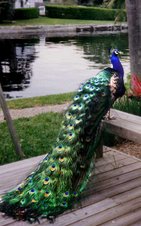
Our last photo of the peacock we named Lord Byron.
The blue peacock, the one my wife nicknamed "Lord Byron" because of his magnificent plumage, is dead. He was the last of Ms. Bird's two chicks, born in July, 2014.

He had been watched with delight by the entire neighborhood.

We spotted his feathers dragged along the center of NE 18th Street at Victoria Park Road this morning on our walk. His feathers are unmistakable, of course. Obviously he had been hit by a vehicle.

It appears someone had removed as much of the body as possible. That was a merciful thing to do.

We have not spotted Ms. Bird so far this morning. We have no reason to believe she was hurt and we hope she is OK and was not driven off.

Peacocks are wild animals, and the ones in this neighborhood have never really been pets, although some residents have claimed to have tamed them to some degree. There is no way I know to keep them "safe."

Of course they lack knowledge of traffic rules.

Lord Byron, in particular, was becoming a regal male, repeatedly spreading his feathers to boss around the local ducks and pigeons. Dominance was becoming his business, as it is for male peacocks.

He was wary, but never afraid.

We enjoyed his displays but will always remember him best as the gawky chick he was, the apple of his mother's eye.

Saturday, September 5, 2015

Big blue bird and his big blue bird bath

Lord Byron at his favorite perch.
The big blue peacock we call Lord Byron has a favorite perch in our backyard: a blue ceramic bird bath.

None of the other peacocks who've graced our lives have bothered with bird baths, not even to drink. But Byron loves to stand in this one, gazing out over the Middle River.

He doesn't bathe; rarely seems to drink. Maybe he just likes to cool off his "toes."

He looks so lordly standing there, and — you know — so blue. Does he sense that it's the right color for his plumage to show to advantage?

More importantly, does the peacock understand that the ceramic bowl is not permanently attached to the base and his weight could cause it to tilt and fall off? We try to keep it full of water to help offset his weight on the edge.

Saturday, August 29, 2015

Ms. Bird and her growing chick find one another

Mother and child reunion.
Ms. Bird and Lord Byron found one another soon after her return from treatment at the Wildlife Center.

Both discovered they love kale, a new menu item Bonnie introduced to add calcium to their diet. Advice on the Internet is that females need calcium to produce eggs with shells hard enough to make them easy to push out. We're concerned Ms. Bird had trouble with that.

Of course the peacocks eat what they want when and if they want anything. Often they ignore food we offer. Our neighbors offer a variety of things as well, and we see the birds hunting (for bugs?) constantly.

Their relationship is interesting. Lord Byron still seems to follow his mother around; she seems to prefer a bit of privacy. Perhaps she instinctively will not want him around next time she lays. Sometimes there's a peck or the threat of it to warn him off.

And her concern may be well founded as, in her absence, Byron was often seen standing alongside a clutch of young Muscovy ducks in the neighborhood. It wasn't clear if he was there to intimidate them or merely to be a chick himself.

He's only a year old, still too young to become a father.

Tuesday, August 25, 2015

Ms. Bird nursed back to health by Wildlife Center

Wildlife Center worker takes ailing
Ms. Bird in for examination.
Ms. Bird got another visit to the South Florida Wildlife Center this month.

The South Florida Wildlife Center is a partner of the Humane Society of the United States. The people there really care. The operation is impressive. An "ambulance" responded when we called Aug. 15 to report that Ms. Bird seemed in distress.

She wasn't eating, neighbors reported, and she had spent the night before on a low perch instead of high in a tree as usual. In the morning she stayed on that perch, appearing to be asleep sometimes.

Neighbors agreed that it was time to call for help. I made the call and a worker came right over and collected her.

The diagnosis, apparently after X-rays at the Center, was that she had a collapsed egg inside her. (We knew she had built a nest but hadn't laid any eggs.)

We read on the Internet that having an egg stuck is a life-threatening condition.

After it was removed and a course of drugs was administered Ms. Bird was released to us to be returned to her home neighborhood. We brought her back in a borrowed cage.

We're glad to have Ms. Bird back and grateful to the South Florida Wildlife Center for helping her back to health.

Back in her old neighborhood Aug. 25, 2015.

Wednesday, June 10, 2015

A peachick grows up in Fort Lauderdale

Lord Byron briefly holds court atop our wooden table.
He's now regularly called "Lord Byron" by Bonnie and I but I don't think any neighbors know that's our name for the blue peachick. He's a big, beautiful creature now, and independent of his mother (which seems to suit her fine).

Unlike his mother, Lord Byron doesn't seem to attach any particular importance to our yard and is more often seen elsewhere. He likes to hang with the crowd of Muscovy ducks when they gather on Victoria Park Road but later you might see him sitting regally atop a roof.

This morning, however, he stopped by and hopped up on the birdbath in our backyard. He's not thirsty; just looking around. His mother never did this.

But, later, he rested briefly on the wooden table on the deck, just as she used to do (but hasn't lately). I managed to get this one photo, but he didn't stay long and he left no feathers.

Sunday, March 15, 2015

Video shows that peacocks are very alert

Notice the "flighty" awareness of the blue peachick as it eats a handful of seeds presented at the back door of our Poinsettia Heights house.

The bird seems to respond to the least noise, including a shout from down the block and the whispered voices of my daughter and her boyfriend as she shot this video.

Even the movement of the white, mother peahen in the background causes the peachick to jump.

Notice, too, the almost soundless "peep" the bird makes itself. We've noticed before how this sound is almost completely directionless; hard to tell where it's coming from, something that no doubt aids peahens in finding their chicks but does little to direct predators to the target.

I've taken to calling this bird Blue Bird, now that there is only one blue peachick left alive to name. My wife, Bonnie, is trying to push for the far grander name "Lord Byron."

Thing is, everyone on the block will have their own name for the bird; Blue Bird at least will eliminate any doubt which bird we mean when we discuss the peacocks with our neighbors!

Tuesday, February 10, 2015

Drama in the wild kingdom as a big bird visits

Peacocks watch as a big visitor takes to the air between them.
(Photo by Bonnie Gross)
The two peacocks in the neighborhood were interested to see a big white bird on the lawn in front of a house on Northeast 21st Street, and approached to check it out.

The big white bird — a great egret, I presume — wasn't looking for company but it had its eye on prey (a lizard?) in the those bushes and wasn't going to flee until it got it.

The blue peachick eventually started doing its silly raised-feather salute but Ms. Bird stayed calm as she edged closer. Perhaps, with its long neck, she thought it might be another white peahen?

Certainly the peacocks were showing much more interest in this bird than they do in the old-hat Muscovy ducks in the neighborhood.

Ultimately the big bird got its meal and immediately took off. That's when Bonnie clicked the shutter and nailed this great photo.

Ms. Bird took the egret's take off calmly but blue bird went all haywire, running across the road as if to chase the big bird... on foot. Ms. Bird chased her chick with that "there the kid goes again" concern every parent would recognize.

The big bird soared past one more time as if to rub in its superior flying skills and soared off over the rooftops.

Friday, January 9, 2015

A sad, sudden end for one peachick

One of the peachicks; it was never easy to tell them apart.
Ms. Bird's peachicks gained size fast, which we assumed gave them protection from predators. Despite their size, they remained chicks in behavior. While Ms. Bird was constantly on alert, scanning her surroundings, the chicks would become preoccupied with whatever they were doing.

This would then result in sudden panic when any threat appeared, or even if their mother had moved to be temporarily out of sight. The chicks would startle, behaving "like chickens with their heads cut off."

This seems to have caused the death of one of the chicks the late afternoon of Jan. 2, 2015.

I was in the house when I heard persistent and obviously alarmed crowing from Ms. Bird. I got up to investigate, but turned back and grabbed my camera, thinking I might get a shot of this occasional behavior.

The last photo I have of the three birds together.
Peachicks are easily as big as Ms. Bird!
On the front sidewalk I encountered a neighbor, John, walking his own large dog on a leash. As we met, a large brown dog I didn't recognize walked out of the side yard of my house toward John.

"Do you know this beast?" I asked John, ironically, wondering why it would be on the loose. He said he knew the dog from the neighborhood, and called it by name, indicating he would take charge of it.

"THAT bird," he said, nodding to my side yard, "flew all the way up and hit the high tension power line. I think he may have been shocked."

I looked down the side yard and spotted one of the peachicks lying on its side, on the ground. Ms. Bird was above it, on the roof line of the neighboring house, continuing to crow loudly.

At this moment I must have taken a photo of the scene, although I don't remember doing so. I was shocked later to find a blurry photo on the camera. Ms. Bird, being all white, may be invisible in the washed out area above the roof, or perhaps had moved just out of sight. She never stopped crowing loudly.

The photo I don't remember taking. Crumpled bird barely visible.
What I do remember doing is approaching the injured bird and taking it into my arms — it made only one off-center scrape along the ground trying to escape me and then did not resist. It looked at me. It was still alive but I felt no heartbeat.

I asked John to summon Bonnie. He again described the bird flying into the power line that runs along the sidewalk, right by the power pole, and then plummeting straight down. My guess is that the bird was startled by the big dog and flew into the spider web of power lines that meet at the pole.

Perhaps it was shocked, or perhaps the impact with wires and fall proved fatal (I would subsequently find a large feather and lots of blue/white peachick fluff directly under the pole). John told me the fallen bird had gotten up the length of the side yard on its own speed, fleeing the big dog.

The dog may have been just curious and may never have touched the bird for all I know.

The peachick died before we could get it to the Wildlife Care Center. We left the body with them.

A neighbor pointed out that it might have been better to bury the bird at home, with Ms. Bird watching. It might have prevented what we saw the next day: Ms. Bird and the remaining chick seemingly frantically searching.

The deceased chick had been the larger of the two and had been showing signs of being dominant, even pecking at Ms. Bird and its sibling to establish who would eat first.

"Oh, that was her favorite," another neighbor said when told of the death. How much we read into these birds our own emotions! I was just glad that I got to hold the chick at the end and grateful that humans have arms that can enfold other creatures. Perhaps it matters to them. It certainly did to me.

Monday, August 18, 2014

Chicks growing in size — and wisdom?

Side-by-side in apparent harmony.
In the month since my last post the two peachicks have gained considerable size but they continue to shadow Ms. Bird (sometimes she seems to be following them).

We suspect that size is important to safety, as there is a hawk in the neighborhood. Recently Ms. Bird honked frantically, and noisily flew to a rooftop, apparently upset that the hawk had swooped past. I saw the hawk but of course there was nothing I could do to help but clap my hands fast and loud to shoo it off.

With the hawk apparently out of sight Ms. Bird hopped down from the roof and began looking for her chicks, who had taken shelter under a bush. With her clucking and the chicks peeping the little family eventually homed in on one another.

Days later we saw the hawk take a mourning dove (a bird the size of a pigeon). It had no difficulty whatsoever in carrying off its prize.

It's a dangerous world out there.

Saturday, July 19, 2014

Ms. Bird's two chicks show some personality

The chicks seem more aware and stronger every day.
Still unnamed, at least by us, Ms. Bird's two chicks seem to be growing larger and stronger and more aware by the day. It is not hard to imagine that they might soon be roosting in trees.

The little family trio is inseparable for the moment. The chicks love watching their mother, who can not tear her eyes away from her young.

The chicks seem to mimic her moves, fanning their little fans when she does and watching what she eats for clues to what might be tasty.

Although we haven't named the chicks, Bonnie swears that one is larger and stronger and therefore possibly a male. I say it's too soon to tell anything.

Also, there is so much "me too, me too!" scurrying constantly going on that I can't imagine telling them apart at this point. It's hard to even focus on one or the other. Most photos are blurred by their constant motion.

Watching mom and being watched are big activities.

There is no more doting mother than Ms. Bird.

Tuesday, July 15, 2014

Ms. Bird has two chicks

Ms. Bird and her two chicks posing on the picnic table benches.
"She's here! She has chicks! Get a camera!" I whispered/shouted to Bonnie just after stepping out the door into the front yard Monday morning.

There, looking tentative but proud was Ms. Bird, shepherding two active and fluffy chicks through the perennial peanut ground cover in our front lawn.

It was as though she had brought them by to show them off. Bonnie struggled to get pictures (the chicks wouldn't hold still and nearly disappeared as they struggled through the ground cover).

But by today they were ready for their close-up. The chicks followed Ms. Bird and hopped up onto the back deck. Here they could be photographed through the windows.

To our surprise the chicks proved capable of hop/flying onto the wooden picnic table benches and one hopped up onto a birdbath. Once that chick was on the birdbath it was at Ms. Bird's eye level.

She took the opportunity to examine her chick thoroughly, from point-blank range. She admired and admired the young one.

Ms. Bird can not get enough of her chicks.
It's no surprise. She has been alone for so long now and here, at last, is one of her own kind and its all hers. How she must adore them.

We haven't bestowed names on the chicks. These are wild birds and there are many dangers out there. We don't want to get too attached.

But it is hard not to admire the care Ms. Bird lavishes on her little ones. She will do all she can to keep them safe.


Saturday, June 12, 2010

Welcome home, Ms. Bird


She's back. After three weeks of antibiotics and excellent care at the Fort Lauderdale Wildlife Care Center, Ms. Bird was ready to come home.

Dr. Schneider, the vet who cared for Mr. Bird every time he was sick, said she had a bad bacterial infection. She didn't think she was just traumatized by losing her eggs, although she said not to bother taking them away next time. A peahen might just lay more, depleting her calcium supply.

Ms. Bird has been hanging out in our backyard, ignoring all seeds and treats we put out there -- just being a bird.

It's great to have her back.

Here are photos of her return.


Saturday, May 22, 2010

Ms. Bird goes to the hospital: Is she sick or just depressed?


We were awakened at 7:30 a.m. today when our neighbor called to report Ms. Bird's disturbing behavior. Not roosting in a tree as is her normal practice, she stood all night on her covered patio, hunched over, with her head down – a portrait of patheticness – or perhaps depression.

She ignored food, water and people, allowing neighbor Sophia to pet her. (She would be way too wary for this normally.) Her eyes were closed, and seemed to have fluid around them.

By her appearance, it was clear she was in bad shape.

Now, keep in mind, this is one day after we removed her eggs from her nest, which clearly upset her.

Neighbors Lee and Sophia wanted to call the wild-bird doctor or the wildlife care center.

After seeing her condition, I agreed we needed professional help. I called Dr. Renata Schneider, the vet who cared for Mr. Bird, but got a phone message saying she was on maternity leave.

Next, I called the Wildlife Care Center, which agreed to come out first thing and take her into their care.

The sad bird put up little struggle when the wildlife worker went to grab her and put her in an animal crate. In a moment, she was off to the hospital.

(Just an aside: How is it possible that a sick peahen gets better, quicker medical care than a sick child?)

Later, we visited the Wildlife Care Center and were happy Dr. Schneider, Mr. Bird's doc, had come in and was examining her.

We don't have a diagnosis yet, but we know she's getting the best care possible.

We wonder, though: Is it really possible for a peahen to be so sad that she makes herself sick?

I was surprised when the fellow with whom I spoke at the Wildlife Care Center considered that a viable option – that she was suffering from depression. He suggested that when we get her back, we get another peafowl for company.

First, though, let's get Ms. Bird well.

Friday, May 21, 2010

Nesting can be dangerous, which is why it's over


Three of Ms. Bird's eggs next to a chicken egg. (Guess which is which.)

We were worried about our lovely peahen Ms. Bird spending the night on the ground sitting on her newly laid eggs. After all, Mr. Bird was 6 feet off the ground when a evil raccoon dragged him down and killed him about a year ago. There are predators out there!

So, last night at 5:30 a.m., when David awakened to Ms. Bird's squawks (didn't wake me!), we were alarmed.

Indeed, we got up and, from our dining room, shined a flashlight at the nest. No Ms. Bird. She had fled.

But there was a great big evil-looking possum approaching those big eggs. From inside, I yelled at him and he cowered, pulling back. Eventually, David got dressed and we scared the opossum away.

But there was no sign of Ms. Bird. Just a few feathers where her nest and four perfect eggs sat.

Despite the hour, we both paced the yard, searching for a sign of her. None.

Then the question: Should we take the eggs — we were 99.9% sure they were infertile — to prevent her from sitting on them for days, at the risk of her life?

We decided to take the eggs inside, where they would be safe from the opossum. We "candled" the eggs with the powerful flashlight, determining they were not fertile. Then we went back to sleep.

At 6:30 a.m., we were up. She still wasn't on the nest.

We worried about Ms. Bird and her whereabouts. A few hours later, we heard that honking/squawking noise.

Here she was — heading for her egg-less nest.

It broke our hearts to see her hunting for those missing eggs. She honked and honked. She sat on the place where they had been, then got up and looked around. ("Now where did I leave those eggs?")

It took a long time, but she eventually moved on, a broken hearted mother. But she was behaving instinctively. She couldn't know that the eggs would never hatch into chicks and she would have risked her life sitting on them for 28 days or more.

Meanwhile, these enormous peafowl eggs are now in our fridge.

David says: Make am omelet. They were not fertile, and it is a sin to waste them.

I'm not sure yet.

Thursday, May 20, 2010

Congratulations? We have eggs!


Mystery solved.

Ms. Bird, our neighborhood's lovely white peahen, has laid four eggs in our bushes. Mid-day, I heard that same strange honking outside and rushed out to see what she was doing. She was noisily walking and squawking through the back yard, so I peered over at where she had been so resolutely sitting in the bushes.

Yup. Four eggs: A bit bigger than chicken eggs, but not enormous.

I snapped the photo, went inside to send it to folks, and, within 10 minutes, she was back sitting on those eggs again.

A good mother. Ummm. But I don't think our celibate girl is sitting on anything that's going to hatch.

Maybe the recent honking was part of the nesting routine. Maybe she's been hiding in the bushes with her secret eggs for awhile.

(I am tempted, at this point, to say "only time will tell." Except I can never write that, because I make my Florida Atlantic University students excise if from their blogs and challenge them to find original words to express themselves.)

So: We'll see, I guess.

Breaking news: We think Ms. Bird is sitting on eggs


We were disturbed last night to discover Ms. Bird cozied up in a corner behind some bushes as the sun set after a rainy day. She has always, to our knowledge, roosted in a tree.

It wasn't easy to spot her. She's well-hidden, though right below our dining room window, so we can see her if we look directly down.

This morning, alas, she was still there.

Our first thought: Oh no. She's sick!

And then it occurred to David: It's spring, she has laid some eggs.

Of course, we don't think there's been a male around, but chickens lay infertile eggs, right?

A little online research indicates that indeed peahens, beginning around age 2, will lay eggs once a year without males if they are healthy and well-nourished.

If fertile, the eggs take 28 days to hatch.

Does that mean poor Ms. Bird is stuck in the bushes without food or water for 28 days sitting on infertile eggs?

We tried putting out some seeds this morning. She didn't budge.

Do we bring food and water to her nest?

Royal Enfield Motorcycles